HPE CDS Tech Challenge 2024 — Winner
Six months of elimination rounds, then a medical assistant built overnight in Madrid.
The competition
The HPE CDS Tech Challenge is Hewlett Packard Enterprise’s Spanish talent competition, and 2024 was its third edition. Close to 300 university and vocational students from more than 70 institutions entered — a 17% jump on the previous year — and the whole thing ran for six months in three phases:
- November 2023 to February 2024 — four monthly engineering challenges, in Docker, Java and Python, ranging from urban traffic problems to AI-flavoured cybersecurity scenarios. Failing one meant elimination.
- Phase two — a proof of concept. Design a medical application and build a working demo of it. Twenty-five teams were left going in; five came out.
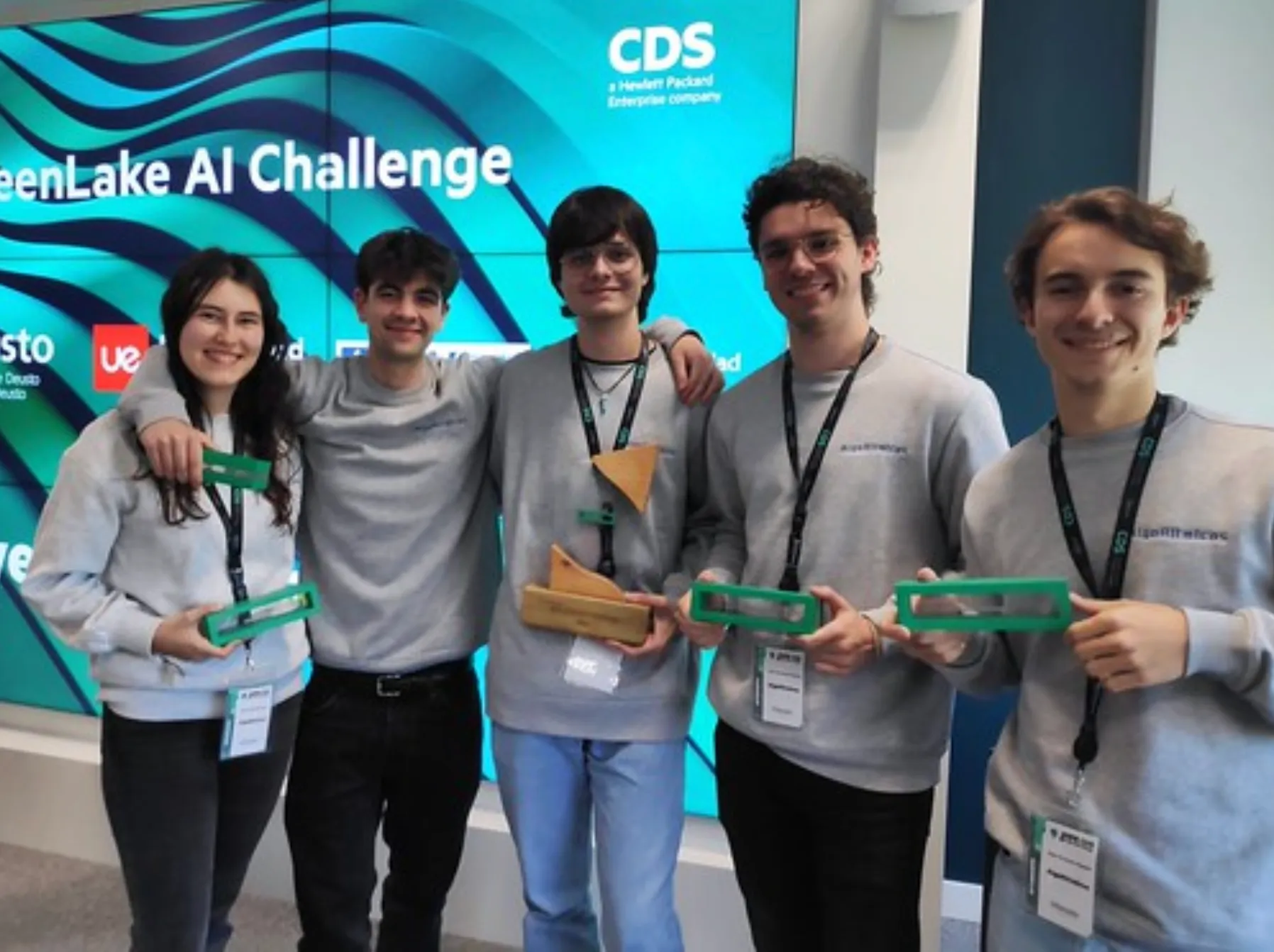
- April 27–28, 2024 — the final hackathon in Madrid. The five surviving teams, a single continuous overnight coding session, and a panel of technical and non-technical judges.
The five finalist universities were Carlos III, Universidad Europea, Francisco de Vitoria, Universidad de León and Universidad de Deusto. I was on the Deusto team.
The framing for the whole edition was responsible AI: the brief asked what artificial intelligence can do for efficient and equitable global governance, and how you mitigate the ways it gets misused. That constraint shaped what everybody built — this was not a “ship anything” hackathon.
What we built
Team Algorrítmicos — Sara Hernández, Aitor Hernández, Jorge Alcorta, Unai Igartua and me.
The final brief was a medical application giving recommendations across physical health, mental health and general wellbeing. In 24 hours of uninterrupted work we built a Retrieval-Augmented Generation system, served behind an API, that answers natural-language health questions in multiple languages against a retrieved evidence base rather than freewheeling from model weights. Grounding the answers was the whole point: in a health context, a confidently invented recommendation is the failure mode you have to design against.
On top of that we added an emergency first-aid module that accepts three input modes — text, audio and image. The reasoning was situational: someone who needs first-aid guidance may not be in a position to type. They can speak, or they can point a camera at whatever has happened.
The result
We won, against the four other finalist teams, after deliberation by the judging panel. The prize was employment and internship offers from HPE plus a certification course, Specialist — Deep Learning in Theory and Practice.
The competition got national tech press coverage in Xataka, linked above.
What I took from it
Six months of monthly elimination rounds is a different kind of pressure from a weekend hackathon — you carry a team through it, and one bad month ends the run. The final 24 hours were the easy part by comparison: by then the question was just scope discipline, deciding what a demo genuinely needs and refusing to build anything else.